





RaySpace

A Comprehensive Asset Detection and Detailed Display System Integrating Asset Inventory, Risk Detection, and Risk Management for Cyberspace Assets.

Current Location: Home > Products > Network Security > RaySpace
Product Overview
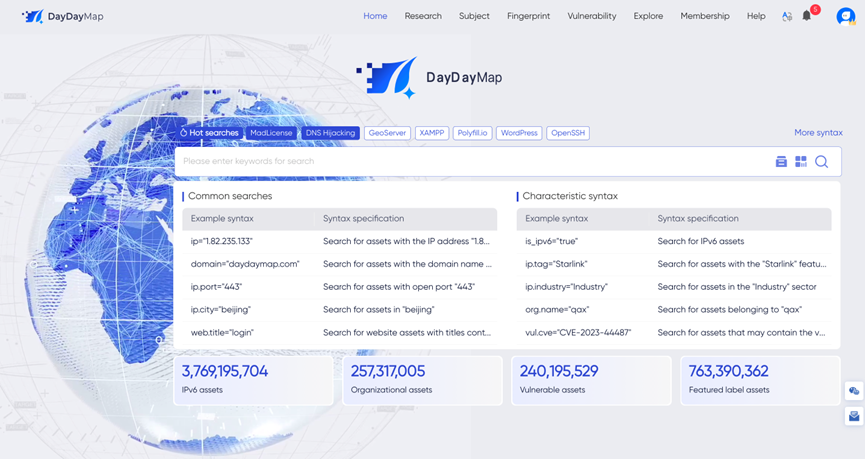
RaySpace, the Network Asset Detection System developed by WebRAY, is an integrated solution for asset discovery, risk detection, and risk management. Combining vulnerability detection technologies with data intelligence analysis, it enables rapid detection of the status of IPv4, IPv6, and domain assets in cyberspace. The system is capable of precise discovery, identification, and threat detection for all types of assets across the entire network. RaySpace is built on three high-performance detection engines: Asset Alive Detection, Fingerprint Detection, and PoC Detection. Leveraging extensive resource libraries, including the asset fingerprint database, CVE vulnerability database, and PoC rule database, it enables accurate identification, discovery, and security detection of cyberspace assets. This allows for comprehensive visibility into the security risk situation of network assets, enhancing asset security governance and reducing the cost of asset security maintenance.
Product Competence
The Technical Committee on Cyberspace Security

WebRAY is a Vice-Chairman Unit of the Technical Committee on Cyberspace Security of the Chinese Institute of Command and Control (CICC).

Release of the First Cyberspace Map

In 2022, WebRAY took the lead in releasing the Cyberspace Kunyu Map, creating a security baseline for the construction of China's digital infrastructure.

Selected in the Professional Technical Report

WebRAY has been repeatedly included in IDC's "Cyberspace Map Market Insights" report and recognized as a representative vendor in this field.

Key features
  • Asset Alive Detection

    Supports IPv4/IPv6 dual-stack probing, as well as domain name probing, to identify alive assets and lay the foundation for further asset and risk inventory management.

  • Fingerprint Detection

    Capable of comprehensive attribute identification for specified IPv4/IPv6 address ranges, including the ability to detect asset attributes such as services, operating systems, device types, vendors, and components.

  • Vulnerability Matching

    Identifies and matches asset vulnerabilities through banner information, supporting the detection of 30 vulnerability types, including security attributes, boundary condition errors, code issues, and Cross-Site Request Forgery (CSRF).

  • PoC Detection

    Supports targeted packet verification through over 5,400 existing PoC plugins to identify the vulnerability risks of assets

Key Technologies
Establish a Multi-Dimensional Asset and Risk Registry
The system helps users create a comprehensive asset and risk library through periodic asset and vulnerability assessments. On one hand, it clarifies asset details, enabling users to accurately understand the distribution and attributes of all assets. On the other hand, it facilitates the timely detection of changes in asset vulnerability risks, helping to quickly identify high-risk assets.
Precise Asset Risk Localization
After establishing the registry, the cyberspace asset detection system acts as an efficient search engine, enabling rapid search of asset attributes and vulnerability information using specified keywords. For example, it can search for high-risk vulnerabilities and quickly identify exposed attack surfaces, enabling targeted investigations.
Cyberspace Asset Profiling
Conducts in-depth asset profiling from both vulnerability and fingerprint dimensions, and visualizes the results for display. It also supports visualizing the relationships of target cyberspace assets, constructing an asset network topology. This is based on the correlation of assets across various dimensions, including certificate acquisition, C-class asset association, Whois lookups, and r/fDNS lookups, along with other related assets.